The Question Every Homeowner Faces
Sooner or later, a roof problem forces the question: do I patch this up, or is it time for a new roof? It’s an expensive decision in both directions — an unnecessary re-roof wastes thousands, while flogging a dying roof with repeated repairs wastes money slowly and leaves you with the big bill anyway. Getting it right matters, and the good news is that the decision usually comes down to a few clear factors rather than guesswork.
The honest starting point is this: most roof problems are repairs, not replacements. A roof is a big, robust system, and a slipped tile or a failed flashing is a local fault, not a sign the whole thing is finished. Any roofer who reaches for "you need a new roof" at the first leak deserves a sceptical eye. But there is a genuine tipping point where repair stops making sense, and knowing where it lies keeps you from either extreme.
The Three Factors That Decide It
Three things determine whether a roof should be repaired or replaced, and weighing them together gives you the answer in most cases.
- How much is damaged. The rough rule is 20%. If under a fifth of the roof is affected and the rest is sound, repair is almost always the better value. Once damage is widespread across the whole roof, the economics shift towards replacement.
- The age and life of the covering. Concrete tiles last 40–60 years, clay 60–100, slate 100+. A fault on a 15-year-old roof is a repair; the same fault on a 55-year-old concrete roof that’s carbonating and shedding tiles across every slope is a sign the covering has simply run out of road.
- The condition of the underlay and structure. This is the hidden factor. Tiles can be re-laid, but if the underlay beneath has perished and the battens are failing, you’re repairing over a foundation that’s gone — and the next failure is always coming. Perished underlay across the roof is the strongest single argument for replacement.
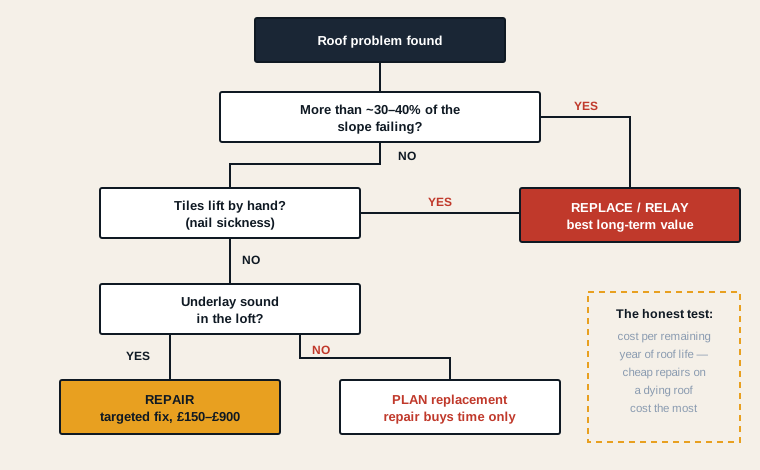
NFRC guidance notes that where a roof covering has reached the end of its serviceable life or the underlay has failed, piecemeal repair becomes a false economy, as further failures follow and the cumulative cost exceeds a planned replacement.Source: NFRC
When Repair Is the Right Call
Repair is the sensible choice more often than not. If your roof has a specific, identifiable fault — a run of slipped tiles, a leaking valley, a failed chimney flashing, some cracked ridge mortar — and the rest of the roof is sound, fixing that fault is far better value than replacing a roof that has years of life left. This is especially true on younger roofs and on well-built older ones that have simply developed a local problem.
There’s also a specific Farnham case worth highlighting: nail sickness on the town’s Victorian slate roofs. When old iron nails corrode and slates start slipping across a slope, it can look like the roof is failing — but the slates themselves are often perfectly sound. Re-nailing the slope with copper fixings is a repair, at a fraction of the cost of a re-slate, and it can give a Victorian roof another few decades. A roofer who quotes to re-slate a roof that only needs re-nailing is either not looking properly or not being straight with you.
When Replacement Makes Sense
Replacement becomes the better decision when the signs point to whole-roof failure rather than a local fault. The clearest indicators are: tiles or slates failing across the whole roof rather than in one area; underlay that has perished so it no longer sheds water; battens failing throughout; recurring leaks in multiple, different places; visible sagging in the roofline; or a covering that has simply reached the end of its design life. When several of these are present together, patch repairs become a false economy — you fix one leak and another appears, and the running total soon overtakes what a planned replacement would have cost.
On Farnham’s post-war estates — Heath End, Badshot Lea, Weybourne — this tipping point is arriving now for a lot of houses. The concrete tiles fitted in the 1950s and 60s are carbonating: the cement surface breaks down, the tiles become porous and brittle, and once that’s happening across the whole roof, individual repairs stop being worthwhile because the next brittle tile is always about to go. A roof at that stage is better replaced in one planned job than nursed through a series of emergency call-outs.
How to Get a Straight Answer
For borderline cases — and there are plenty — a proper roof survey settles it. A good roofer will assess not just the visible fault but the covering across the whole roof, the state of the underlay and battens where they can see them, and the structure, then give you an honest read on whether targeted repairs will genuinely last or whether you’d be throwing money at a roof that needs replacing. That assessment is worth having before you spend either way.
The key is honesty, and it cuts both ways. A roofer who always says "repair" may be avoiding the harder conversation you need to have; one who always says "replace" may be chasing the bigger job. What you want is someone who’ll tell you your 15-year-old roof just needs a flashing sorted, and equally will tell you your 55-year-old concrete roof is past nursing — and show you the evidence for both. That’s the roofer worth trusting with the decision. If you’re weighing it up on a Farnham property, we’re happy to take a look and give you a straight answer.
The Middle Path: Partial Re-Roofing
The repair-or-replace question isn't always binary. Sometimes the right answer is a partial re-roof — replacing one elevation or slope that's failed while leaving sound slopes alone. This is common on properties where one aspect takes far more weather than the others, which in Farnham often means the south-westerly-facing slopes on exposed, higher ground that have weathered harder than the sheltered sides. Re-covering the failed slope in matching materials, while repairing the rest, can be a sensible middle path that avoids the cost of a full re-roof without the false economy of patching a genuinely failed slope.
Partial re-roofing only works where the materials can be matched and the sound slopes genuinely have life left — there's no point re-covering one slope if the others will fail within a couple of years, since you'll just be back for scaffold twice. A good survey will tell you whether your roof is a candidate. On period properties in the conservation areas around The Borough and Castle Street, matching materials for a partial re-roof also needs care to satisfy Waverley Borough Council's expectations, which is another reason to get the assessment right before committing either way.
Frequently Asked Questions
Repair if under 20% is damaged and the covering, underlay and structure are otherwise sound. Replace if tiles are failing across the whole roof, the underlay has perished, repairs keep recurring, or the roof has reached the end of its life. Most problems are repairs; a survey settles borderline cases.
By its age and the pattern of failure. Concrete tiles last 40–60 years, clay 60–100, slate 100+. When tiles are failing across the whole roof rather than in one spot, the underlay has perished, and repairs no longer hold, the covering has run out of life — replacement beats repeated patching.
A repair is far cheaper upfront and is the better value when the roof is otherwise sound. But repeated repairs on a failing roof become a false economy — the cumulative cost overtakes a planned replacement, and you still end up needing the new roof. The trick is judging which situation you’re in.
Nail sickness is corroded iron nails letting sound slates slip — common on Farnham’s Victorian roofs. It looks like roof failure but usually isn’t: re-nailing the slope with copper fixings is a repair at a fraction of a re-slate’s cost. Don’t let a roofer talk you into replacement for what re-nailing would fix.
Concrete tiles carbonate with age — the cement surface breaks down, and after 50-odd years they become porous and brittle. Once that’s happening across the whole roof, as it now is on many Farnham post-war estates, individual repairs stop being worthwhile because the next tile is always about to go. Replacement is usually the better call.
Get a second opinion if in doubt. A trustworthy roofer explains their reasoning and shows you the evidence — the perished underlay, the widespread tile failure — rather than just declaring you need a new roof. One who always recommends replacement, or won’t explain why, is worth double-checking. An independent survey gives you an honest read.
Last reviewed: 12 September 2026